How Long to Grill Chicken Strips Step by Step
To grill chicken strips perfectly, preheat your grill to 375-400°F and oil the grates to prevent sticking. Properly grilling chicken strips ensures juicy, flavorful results every time.
Place evenly cut strips on the grill, leaving space between each.
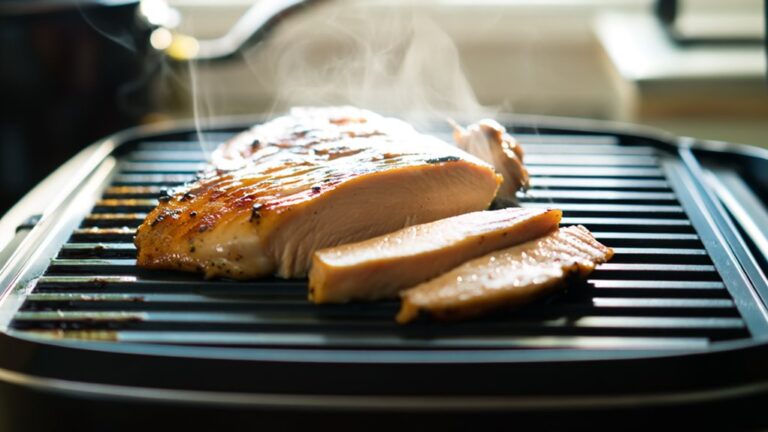
Cook the chicken strips for 3 to 4 minutes per side without moving them to get nice grill marks. Flip once and check that the internal temperature reaches 165°F for safety.
After grilling, let the strips rest a few minutes to lock in juices.
Keep going if you want tips on marinades, tools, and serving ideas to enhance your grilled chicken strips experience.
Key Takeaways
- Preheat grill to 375-400°F and lightly oil grates to prevent sticking before placing chicken strips.
- Grill chicken strips about 3-4 minutes per side, flipping once halfway through for even cooking.
- Maintain spacing between strips and position them perpendicular to grates for proper grilling and avoiding falling through.
- Use a meat thermometer to ensure internal temperature reaches 165°F for safe consumption.
- Let grilled chicken strips rest 2-3 minutes covered loosely with foil to retain juices and enhance flavor.
Preparing Your Chicken Strips for Grilling
Before you start grilling, make certain to choose fresh, boneless, skinless chicken breasts or tenders for even cooking. If you’re using chicken tenders, cut them into uniform strips about 1 inch wide to guarantee they cook evenly. Next, marinate the chicken in a flavorful marinade—think olive oil, vinegar, and your favorite spices—for at least 30 minutes.
This not only boosts flavor but also helps keep the meat tender. When you’re ready to cook, preheat your grill to medium-high, around 375 to 400 degrees Fahrenheit. Just before placing the strips on the grill, season them with salt and pepper to enhance their taste without drawing out moisture.
Keep an eye on the internal temperature as you cook; chicken strips should reach 165 degrees Fahrenheit for safe consumption. Following these steps guarantees juicy, flavorful grilled chicken every time.
Essential Tools and Equipment for Grilling
Even though grilling chicken strips might seem straightforward, having the right tools can make a big difference in your cooking experience and the final result. Start with a reliable grill thermometer to keep your grill’s temperature steady between 375 to 400 degrees F, the ideal range for chicken strips. Use long-handled tongs to safely flip the strips without risking burns.
To prevent sticking and make cleanup easier, place a non-stick grill mat on your grates or spray them with a non-stick spray. A basting brush is handy for applying marinades or sauces during grilling, locking in flavor and moisture. Finally, a meat thermometer is essential to check that your chicken strips reach the safe internal temperature of 165 degrees F.
With these tools at hand, you’ll grill more confidently and enjoy perfectly cooked chicken strips every time.
Selecting the Right Marinade and Seasoning
You’ll want to pick a marinade that balances acidity and sweetness to keep your chicken strips tender and flavorful. Ingredients like soy sauce, honey, and a touch of vinegar work great together.
Don’t forget to add spices like garlic powder or paprika to boost the taste even more.
Flavorful Marinade Ingredients
Although grilling chicken strips is straightforward, selecting the right marinade can make all the difference in flavor and tenderness. When marinating chicken strips or chicken tenders, focus on marinade ingredients that balance acidity and umami. Lemon juice or vinegar tenderizes the meat, while soy sauce or Worcestershire sauce adds savory depth.
To create an easy marinade, add a touch of honey or brown sugar for subtle sweetness and caramelization during grilling. Don’t forget aromatic spices like garlic powder and paprika, or fresh herbs, to infuse extra flavor. Marinating chicken strips for at least 30 minutes allows these flavors to penetrate deeply, ensuring juicy, flavorful chicken.
With the right flavorful marinade, your grilled chicken tenders will be moist, tender, and delicious every time.
Balancing Acidity and Sweetness
When choosing a marinade for chicken strips, striking the right balance between acidity and sweetness is key to enhancing flavor and tenderness. Acidity from vinegar or citrus juice tenderizes the chicken, while sweetness from honey or maple syrup helps create beautiful caramelization when grilled.
A good rule of thumb is a 3:1 ratio—three parts acidic to one part sweet—so your chicken isn’t too tart or overly sweet. Marinate your chicken for at least 30 minutes, up to 8 hours, to let those flavors really soak in. Adding low-sodium soy sauce brings saltiness and umami without overpowering the balance.
Don’t hesitate to toss in herbs and spices like garlic or paprika to complement the acidity and sweetness in your marinade for perfectly grilled chicken every time.
Seasoning Tips for Tenderness
Balancing acidity and sweetness in your marinade sets a solid foundation, but selecting the right seasoning and marinade ingredients will truly lock in tenderness and flavor. When preparing chicken tenders, marinate them in a mix of salt water, soy sauce, and vinegar for at least 30 minutes to 8 hours to retain moisture through osmosis.
Enhance tenderness by adding garlic powder, paprika, and black pepper to your marinade. For a tangy twist, include lemon or dill pickle juice, which tenderizes and freshens the flavor. Using high-quality olive oil helps prevent drying during the grill.
Finally, season the chicken tenders with salt and pepper right before you grill to boost flavor without losing moisture. These seasoning tips guarantee juicy, tender chicken every time.
Preheating the Grill to the Optimal Temperature
You’ll want to preheat your grill to between 375 and 400 degrees Fahrenheit for the best results. Make sure to give it at least 10 to 15 minutes to reach that temperature, especially if you’re using gas or charcoal.
Using a grill thermometer can help you keep the heat steady while cooking your chicken strips.
Ideal Grill Temperature
Grilling chicken strips at the right temperature—between 375 and 400 degrees Fahrenheit—is essential for juicy, evenly cooked results. To hit this ideal grill temperature, preheating the grill properly is key. You’ll want to let it warm up for 10-15 minutes before cooking.
Using a grill thermometer helps you monitor the heat accurately, ensuring you avoid overcooking or undercooking your chicken strips. Maintaining a consistent temperature throughout grilling is vital; fluctuations can dry out the meat or leave it raw inside. After preheating, lightly oil the grates to prevent sticking and get perfect grill marks.
Preheating Duration Tips
Getting your grill up to the right temperature usually takes about 10 to 15 minutes. During preheating, aim for an ideal temperature between 375 and 400 degrees Fahrenheit, perfect for grilling chicken strips. Make certain your grill grates are clean and lightly oiled to prevent sticking and promote attractive grill marks.
Always keep the grill lid closed while preheating to maintain heat and speed up the process. Using a grill thermometer helps you accurately gauge the temperature, as heating efficiency can vary between grills. Proper preheating is vital—it guarantees a good sear on the chicken strips, which locks in moisture and enhances flavor.
Skipping this step can lead to uneven cooking and dry meat, so don’t rush the preheating phase.
Arranging Chicken Strips on the Grill
To arrange chicken strips properly on the grill, leave enough space between each piece so they cook evenly and don’t stick together. Before placing them, make certain your grill is preheated to 375-400°F for peak searing. Position the strips perpendicular to the grill grates to prevent them from falling through.
Start by placing them on the hottest part of the grill for the initial sear. Once they have good grill marks, you can move them to a cooler section if they need more cooking time. Don’t forget to flip the chicken strips halfway through to guarantee even cooking on both sides.
| Step | Action | Tip |
|---|---|---|
| 1 | Preheat grill to 375-400°F | Use hottest part for searing |
| 2 | Arrange strips with space | Prevents sticking |
| 3 | Position strips perpendicular | Avoid falling through |
| 4 | Flip halfway through | Even cooking |
| 5 | Move to cooler area if needed | Avoid burning |
Timing the First Side on the Grill
Although you’ve preheated the grill to the right temperature, you’ll want to cook the chicken strips on the first side for about 3 to 4 minutes to get a good sear while keeping them juicy. When you grill chicken tenders, be certain the grill grates are oiled to prevent sticking. Place the strips evenly, avoiding overcrowding, so each piece cooks evenly.
Keep an eye on the timing—3 to 4 minutes per side is ideal. During this time, resist the urge to move them around; this helps develop those perfect grill marks and locks in moisture. After this initial cooking phase, check the internal temperature to verify safety, aiming for 165 degrees F.
If you need to remove the chicken briefly, allow the chicken to rest so juices redistribute, enhancing flavor and tenderness. Timing the first side properly sets the stage for perfectly cooked chicken strips every time.
Flipping Chicken Strips for Even Cooking
When you flip chicken strips around the 3 to 4-minute mark on each side, you help secure even cooking and consistent grill marks. Flipping chicken strips gently with tongs prevents tearing and keeps the juices inside, guaranteeing juicy results. Avoid overcrowding the grill; give each strip enough space to allow heat to circulate evenly.
This practice promotes even cooking and prevents some pieces from burning while others remain undercooked.
| Step | Why It Matters | Tips |
|---|---|---|
| Flip at 3-4 minutes | Promotes even cooking | Use tongs gently |
| Space strips apart | Prevents overcrowding | Leave at least 1 inch between |
| Watch grill marks | Ensures consistency | Flip when marks are clear |
| Avoid tearing | Retains juices | Handle carefully |
| Check temperature | Confirms doneness | Use a meat thermometer |
Following these steps optimizes your grilling, giving you perfectly cooked chicken strips with beautiful grill marks.
Checking Internal Temperature for Doneness
To make sure your chicken strips are safe and perfectly cooked, you’ll want to check that they reach an internal temperature of 165°F (75°C). Grab a meat thermometer and insert it into the thickest part of the strip for an accurate reading.
Once it hits the ideal temperature, you can confidently take them off the grill.
Ideal Temperature Range
Grilling chicken strips at a temperature between 375°F and 400°F gives you the best chance of cooking them evenly while achieving a nice, browned exterior. This ideal temperature range is vital for a successful grilled chicken tenders recipe, making sure the strips cook through without drying out. To confirm doneness, aim for an internal temperature of at least 165°F.
When the chicken reaches this temperature, the juices will run clear, signaling it’s safe and perfectly cooked. Cooking within this range helps you avoid overcooking, which can make the strips tough. Remember to flip the chicken halfway through the 6 to 8-minute grilling time to maintain even heat distribution.
Staying within this temperature range assures juicy, flavorful chicken strips every time.
Using Meat Thermometer
Using a meat thermometer is one of the most reliable ways to confirm your chicken strips are fully cooked and safe to eat. When grilling, insert the meat thermometer into the thickest part of the chicken strip, avoiding contact with the grill or pan for an accurate internal temperature reading. You want to check temperature a few minutes before your estimated cooking time ends to prevent overcooking.
If the internal temperature hasn’t reached at least 165°F (75°C), continue grilling and check again periodically until it does. Remember to clean your meat thermometer with soap and water before and after use to avoid cross-contamination. This simple step confirms your chicken strips are juicy, safe, and perfectly cooked every time you grill.
Resting Chicken Strips After Grilling
A brief resting period of 2-3 minutes after grilling lets the juices in your chicken strips redistribute, keeping them moist and tender. When you skip resting, those flavorful juices spill out the moment you cut, leaving your chicken strips dry and less enjoyable. To help with this, cover the chicken strips loosely with aluminum foil while they rest; this keeps them warm without steaming.
During this time, the internal temperature remains safely around 165°F, confirming your chicken is fully cooked. Resting isn’t just about moisture—it also enhances the overall flavor by allowing the juices to settle evenly throughout the meat. So, don’t rush this step.
Serving Suggestions and Pairings
When you’re ready to serve your chicken strips, pairing them with a fresh Greek salad or a hearty side like rice or quinoa can create a well-rounded meal that satisfies both hunger and flavor. Grilled chicken strips go wonderfully with starchy sides such as pasta or quinoa, balancing protein with satisfying carbs. For an extra burst of flavor, finish your grilled chicken with a squeeze of fresh lemon juice and sprinkle herbs like parsley or dill.
Offering a variety of dipping sauces—think homemade barbecue, honey mustard, or tzatziki—adds a fun twist and appeals to different tastes, especially kids. If you’re short on time, try incorporating grilled chicken strips into wraps or sandwiches loaded with fresh veggies and your favorite sauces for a quick, delicious lunch. These serving suggestions make your grilled chicken strips versatile and perfect for any meal or occasion.
Frequently Asked Questions
How Long Does It Take to Grill Chicken Strips?
It usually takes you about 6 to 8 minutes to grill chicken strips, flipping them halfway through to cook evenly. You’ll want to keep your grill at medium-high heat, around 375 to 400 degrees Fahrenheit. Make sure the internal temperature hits 165 degrees to be safe.
Using a meat thermometer helps you avoid overcooking, so your strips stay juicy and delicious every time you grill.
Is It Better to Grill Chicken at 350 or 400 on a Gas Grill?
Grilling at 400°F is like turning up the volume on flavor—it locks in moisture quickly and gives you that tasty char. You’ll cook your chicken strips faster, about 3-4 minutes per side, but you’ll need to keep an eye on them to avoid drying out.
If you want a gentler cook, 350°F works too, offering more even doneness but less caramelization. Either way, aim for 165°F inside for safety!
How Long Do Raw Chicken Strips Take to Cook?
Raw chicken strips usually take about 6 to 8 minutes to cook on the grill. You’ll want to grill them over medium-high heat, flipping halfway through to get even cooking. Make sure they reach an internal temperature of 165°F to be safe to eat.
Using a meat thermometer is super helpful for this. If you want extra flavor, marinate them beforehand for at least 30 minutes.
How Many Minutes Do I Grill Chicken on Each Side?
Grill your chicken strips for 3 to 4 minutes on each side to get that perfect, juicy, and just-charred charm. You’ll want to flip them halfway through to guarantee even cooking and those desirable grill marks.
Remember, thinner strips might need less time, so keep an eye on them. Always check that internal temperature hits 165°F to ensure safety and savory satisfaction.
With patience, you’ll perfect your poultry grilling prowess!
Conclusion
Grilling chicken strips is like painting a masterpiece—you just need the right brushstrokes of time and heat. Once you’ve prepped, seasoned, and grilled them to a juicy perfection, let them rest a few minutes to lock in those flavors.
With every flip and sizzle, you’re crafting a delicious meal that’s ready to impress. So fire up that grill, follow these steps, and enjoy tender, flavorful chicken strips that’ll have everyone coming back for more!
Knowing how long to grill chicken strips is key to achieving that perfect balance of juicy and charred. By mastering the timing, you ensure your chicken strips are cooked thoroughly and remain tender and delicious every time.