How Long to Cook Steak on a Charcoal Grill Step by Step
You’ll want to start by seasoning your steak with salt and pepper, then letting it come to room temperature.
Mastering how long to cook steak on a charcoal grill begins with preparing your meat properly.
Build a hot charcoal fire using the two-zone method—direct heat for searing (2-3 minutes per side) and indirect heat for cooking through, which takes about 5 to 15 minutes depending on thickness.
Use a meat thermometer to check for medium-rare at 130°F to 135°F.
Let the steak rest before slicing.
Keep going to master every step of perfect grilling.
Key Takeaways
- Sear steak over direct heat for 2-3 minutes per side at 450-550°F with the grill lid closed to lock in heat.
- After searing, move steak to indirect heat at around 400°F and cook for 2-11 minutes depending on thickness.
- Use a digital thermometer to check internal temperature: 130-135°F for medium-rare, 140-145°F for medium.
- Remove steak 5-10°F below target temperature and rest for 5-10 minutes to retain juices and improve tenderness.
- Rest steak covered loosely with foil to keep warm; slice against the grain before serving.
Preparing Your Steak for the Grill
Before you fire up your charcoal grill, preparing your steak properly is key to getting the best flavor and texture. Start by applying kosher salt liberally to both sides of the steak a few hours before grilling. This step enhances the flavor, so refrigerate the salted steak for about an hour per inch of thickness.
When ready, remove the steak from the fridge 30 minutes before cooking to bring it to room temperature for even grilling. Trim any excess fat and make vertical slashes in the outer fat ring to prevent curling. When preparing your steak for the grill, season the steak with freshly ground pepper after salting, rubbing it in well to let the flavors penetrate.
Finally, pat the steak dry with a paper towel to remove any surface moisture. This helps you achieve a nice sear, locking in juices and giving your steak that perfect crust. Allowing the steak to reach room temperature before cooking ensures even cooking and a consistent sear.
Selecting the Right Cut for Charcoal Grilling
When choosing a steak for charcoal grilling, you’ll want to focus on cuts known for their flavor and tenderness, such as ribeye, T-bone, porterhouse, and New York strip. The ribeye is especially popular due to its excellent marbling, which enhances juiciness and flavor.
To pick the best cut for your grill, keep these tips in mind:
To pick the best cut for your grill, focus on marbling, thickness, and flavor profile.
- Look for visible marbling—intramuscular fat that keeps the steak juicy while grilling.
- Choose ribeye for a tender, boneless option with rich flavor from its fat content.
- Consider T-bone or porterhouse if you want a combination of tenderloin and strip; porterhouse offers a thicker tenderloin portion.
- Confirm the steak’s thickness is at least 1 inch to cook evenly and maintain tenderness over charcoal.
Following these guidelines will help you select a steak that’s perfect for charcoal grilling, balancing flavor, texture, and cooking ease.
Building the Perfect Charcoal Fire
Although it takes a bit of patience, building the perfect charcoal fire is key to grilling a great steak. Start by filling a chimney with Kingsford® Professional Charcoal Briquets and light them. Wait until the coals turn gray with ash—that’s your signal they’re ready.
Use the Two-Zone Method by piling coals on one side for a hot searing zone while leaving the other side cooler. This setup helps you control the grill temperature around 400°F, perfect for cooking steak evenly without burning. Before grilling, brush the top grate clean to prevent sticking.
| Step | Details |
|---|---|
| Charcoal Preparation | Light briquets until covered with ash |
| Fire Setup | Arrange coals on one side (Two-Zone) |
| Grill Temperature Goal | Maintain about 400°F for medium heat |
| Grill Grate Care | Brush clean before placing steaks |
Building the perfect charcoal fire guarantees your steak cooks just right every time.
Setting Up a Two-Zone Grill for Versatile Cooking
To set up a two-zone grill, you’ll arrange the charcoal on one side to create a hot zone for searing and leave the other side cooler for gentler cooking. This method lets you control the heat better, so you can sear your steak quickly and then move it to the cooler side to finish cooking evenly.
Managing these zones effectively helps you lock in flavor and get the perfect doneness every time.
Two-Zone Setup Benefits
If you want greater control over how your steak cooks, setting up a two-zone charcoal grill is the way to go. This two-zone grill setup gives you the flexibility to manage the grill temp perfectly for different cooking stages. Here’s why it’s beneficial:
- You get a hot side for searing steaks at up to 550°F, locking in flavor and juices.
- The cooler side offers indirect cooking around 300°F, allowing steaks to cook through without burning.
- It lets you switch steaks between zones easily, controlling doneness precisely.
- You can cook multiple items at once, like vegetables on the indirect side, maximizing your grill space.
This setup offers versatility and precision, making your grilling both efficient and delicious.
Arranging Charcoal Zones
Setting up a two-zone charcoal grill is simple and gives you great control over your cooking. Start by arranging charcoal zones with all the coals piled on one side of the grill, creating a hot direct heat zone and a cooler indirect heat area. Use a chimney starter to light your charcoal, waiting until the coals are covered in gray ash before spreading them on one side.
This two-zone setup lets you sear your steak over the intense direct heat, typically between 450-550°F, for a perfect crust. Then, move the steak to the cooler side to finish cooking without burning. Position the grill grate over the coals after cleaning and oiling to prevent sticking.
Mastering this method guarantees versatile and controlled grilling every time.
Managing Heat Distribution
Although managing heat on a charcoal grill can seem tricky, arranging your coals into a two-zone setup makes it much easier. A two-zone grill lets you sear steaks over high heat then finish cooking them gently, controlling their internal temperature precisely.
Here’s how to manage heat distribution effectively:
1. Use a chimney starter to light charcoal until ashy. 2. Arrange coals on one side to create a hot zone (450-550°F) and leave the other side empty for a cooler zone (300-350°F). 3. Sear your steak over the hot zone for a perfect crust.
4. Move the steak to the cooler zone and use a meat thermometer to monitor internal temperature, aiming to transfer it 5-10°F below your desired doneness.
This method guarantees tender, evenly cooked steak every time.
Ideal Grill Temperatures for Different Steak Thicknesses
When grilling steaks, the thickness really guides the ideal temperature you should use. Thinner cuts around 1 inch do well at higher temps near 450°F, while thicker ones need lower heat to cook evenly without burning.
You’ll want to adjust your grill zones accordingly to get the best results for each cut.
Temperature Ranges by Thickness
Grilling the perfect steak depends a lot on its thickness, which determines the ideal temperature and cooking time. To get it just right, use a digital meat thermometer to monitor the internal temperature at the thickest part. Here’s a quick guide:
- For 1-inch steaks, grill at 450°F for 4-6 minutes per side.
- For 1.5-inch steaks, keep the grill at 450°F, cooking 5-7 minutes per side until 130-140°F internal temperature.
- For 2-inch steaks, sear at 400°F for 6-8 minutes per side, then move to indirect heat.
- For 2.5-inch cuts, grill at 375°F for 8-10 minutes per side, finish with indirect heat.
Always check the internal temperature to verify your steak reaches that perfect medium-rare doneness.
Adjusting Heat for Cuts
Since thicker steaks require more careful heat management, adjusting your grill temperature based on the cut’s thickness guarantees even cooking and better flavor. When you grill a steak that’s about 1 inch thick, aim for around 450°F to get medium-rare in 6-8 minutes, flipping halfway through. For 1.5-inch cuts, lower the heat to 400°F and cook for 10-12 minutes.
If you’re dealing with 2-inch steaks, use a two-zone method: sear at 500°F, then move to 350°F to finish, which can take 15-20 minutes. Always monitor the internal temperature with a digital thermometer—130-140°F is perfect for medium-rare, while 160°F confirms well done. Adjusting heat like this helps you cook steaks evenly without burning.
Searing the Steak Over Direct Heat
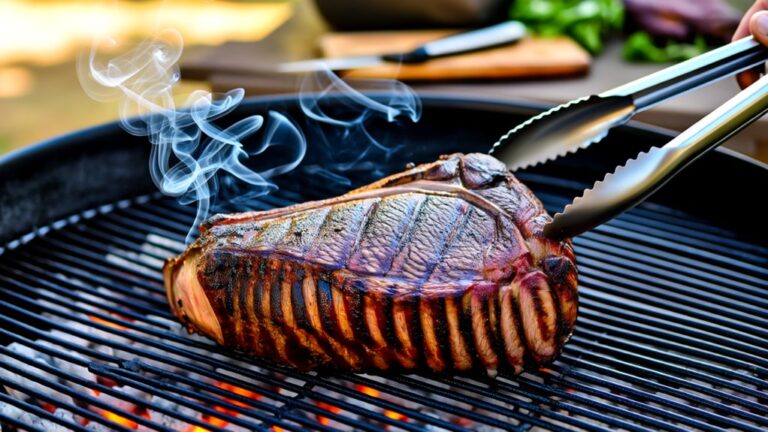
To get that perfect crust, you’ll want to sear your steak over direct heat for 2 to 3 minutes on each side, keeping the grill lid closed to lock in the heat. Searing the steak at a grill temperature between 450-550°F guarantees you develop a flavorful crust and attractive grill marks without overcooking the interior.
Sear steaks 2-3 minutes per side at 450-550°F with the lid closed for a perfect crust.
Here’s how to master searing on direct heat:
1. Preheat your charcoal grill until the temperature reaches 450-550°F for ideal searing. 2. Place the steak directly over the hottest part of the grill and resist moving it to promote even caramelization. 3. Keep the grill lid closed during searing to maintain consistent heat and speed up crust formation.
4. After 2 to 3 minutes per side, transfer the steak off direct heat to avoid overcooking.
Following these steps helps you lock in flavor and texture before finishing your steak to the desired doneness.
Cooking the Steak to Desired Doneness on Indirect Heat
After searing your steak over direct heat, move it to the cooler side of the grill for indirect cooking to avoid burning. Keep a close eye on the internal temperature with a digital thermometer, aiming for your desired doneness.
Indirect Heat Setup
Once you’ve seared your steak for 2-3 minutes per side over direct heat, you’ll want to move it to the cooler part of the grill for indirect cooking. This method helps the steak cook evenly without burning.
Here’s how to set up indirect heat:
1. Arrange your charcoal to one side, creating a hot zone and a cooler zone for indirect heat. 2. Place the steak on the cooler side, away from direct flames. 3. Close the grill lid to maintain a steady temperature around 400°F.
4. Monitor closely—the cooking time varies from 2 to 11 minutes depending on thickness and doneness goals.
Using indirect heat allows the steak to cook through gently while you keep an eye on its internal temperature for perfect results.
Monitoring Internal Temperature
How do you know when your steak has reached the perfect doneness while cooking on indirect heat? The key is monitoring internal temperature with a digital meat thermometer. Insert it into the thickest part of the steak for accuracy.
For a medium rare finish, take your steak off the grill when it hits 130°F to 135°F; it will continue cooking as it rests. If you prefer medium, aim for 140°F to 145°F, and for medium-well, 150°F to 155°F. Once removed, always rest for 5 minutes to let the juices redistribute, enhancing tenderness and flavor.
This precise temperature check guarantees your steak is cooked just right without guessing or cutting into it prematurely.
Adjusting Cooking Time
Though searing your steak on direct heat locks in flavor quickly, you’ll need to move it to indirect heat to finish cooking it to your preferred doneness. Adjusting cooking time during indirect cooking is essential for perfect results. Here’s how to manage it:
- After 2-3 minutes per side searing, transfer the steak to the cooler side of the grill.
- Monitor the internal temperature with a digital thermometer; aim for 130-140°F for medium-rare.
- Adjust cooking time based on steak thickness—thicker cuts require more time, typically 2 to 11 minutes on indirect heat.
- Remove the steak 5-10 degrees below your target temperature, then let it rest 5 minutes to redistribute juices.
Using a Meat Thermometer for Accurate Temperature Checks
When you want to get the perfect steak doneness, using a digital meat thermometer is your best bet. It allows you to check the internal temperature accurately, ensuring your steak reaches your desired level of cooking without guesswork. Insert the thermometer probe into the thickest part of the steak, avoiding bone or fat for the most precise reading.
For instance, aim for 135°F for medium-rare, 145°F for medium, and 155°F for medium-well. Remember to remove the steak from the grill when it’s about 5 to 10 degrees below your target temperature, as it will continue to cook while resting. To keep things safe and hygienic, always clean your thermometer probe before and after each use.
Using a meat thermometer takes the guesswork out of grilling and guarantees your steak is cooked just right every time.
Resting the Steak After Grilling
Once your steak reaches the right temperature, it’s important to let it rest before slicing. Resting the steak allows the juices to redistribute, making it juicier and more flavorful. Here’s how to do it right:
- Rest the steak for at least 5 minutes; thicker cuts may need up to 10 minutes to let the juices fully redistribute.
- Cover it loosely with aluminum foil to keep it warm without causing it to steam.
- Avoid skipping this step, as cutting too soon will cause the juices to escape, resulting in a drier steak.
- Once rested, slice the steak against the grain for maximum tenderness.
Serving Tips to Enhance Flavor and Presentation
A great steak deserves thoughtful serving to boost both flavor and presentation. After grilling steaks to perfection, top your steak with a homemade herbed butter to add a rich, gourmet touch. Slice the steak against the grain for tenderness and arrange the slices neatly on a cutting board or plate.
Drizzle any remaining herbed butter over the top to enhance both taste and presentation. Pair the steak with a fresh mixed green and arugula salad dressed lightly with vinaigrette, providing a crisp, rejuvenating contrast to the meat’s richness. This balance elevates the overall meal without overpowering the flavors you’ve worked so hard to develop.
Take your time enjoying the meal, savoring each bite, and consider pairing it with a wine that complements the steak’s robust flavors. These serving tips guarantee your grilling steaks experience is as impressive on the plate as it is on the grill.
Frequently Asked Questions
How Long to Cook a Steak on a Charcoal Grill?
You’ll want to cook your steak about 4 to 6 minutes per side for a 1-inch thick cut over direct heat, then move it to indirect heat to finish. Use a meat thermometer to check—aim for 130-140°F for medium-rare.
What Is the 3 3 3 Rule for Grilling Steak?
They say, “Good things come to those who wait,” and the 3 3 3 rule for grilling steak embodies that perfectly.
You’ll grill your steak for 3 minutes on one side, flip it for another 3 minutes, then move it to the cooler side for a final 3 minutes.
This method guarantees a great sear and tender inside. Just keep an eye on the temperature to get your perfect doneness.
How Long Do I Grill a Steak at 400 Degrees?
At 400 degrees, you’ll want to sear your steak for about 2 to 3 minutes per side to get that perfect crust. After that, move it to a cooler spot on the grill and cook with the lid closed for another 2 to 11 minutes, depending on thickness and how you like it done.
Use a meat thermometer to hit your ideal temp, then let it rest before slicing.
Do You Close the Charcoal Grill When Cooking Steak?
Don’t count your chickens before they hatch, but yes, you should close the charcoal grill when cooking steak. Closing the lid traps heat, allowing it to circulate evenly around your steak, which helps develop a perfect sear and juicy interior.
It also speeds up cooking, so keep an eye on the temperature. For best results, sear with the lid closed, then move the steak to indirect heat while keeping the lid shut.
Conclusion
Grilling steak over charcoal is both an art and a science, and getting it right means knowing your temperatures and timing. Did you know that 65% of home grillers prefer charcoal for its smoky flavor and better sear? By following these steps—especially using a meat thermometer and resting your steak—you’ll consistently achieve that perfect, juicy bite.
So fire up your grill with confidence and enjoy a delicious steak that’s worth every minute. Remember, mastering how long to cook steak on a charcoal grill is key to unlocking that rich, smoky taste and ideal texture. With practice and the right techniques, your charcoal grilled steak will always impress.